The word « hammam »
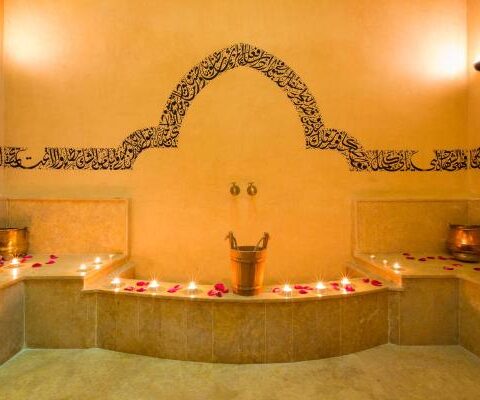
Literally means “hot water” in Arabic (حمام). It is a wet steam bath strongly inspired by the Roman baths. It is distinguished from the sauna by its type of heat: the hammam uses moisture while the sauna is dry.
The Hammam in Morocco as we know it today has a long history. Made of technical, religious or societal aspects, the history of the hammam is still popular today because the steam bath brings unparalleled relaxation and spirituality.
Also called Turkish baths, hammams were born under the Ottoman Empire and more particularly in the Maghreb. Their development is strongly linked to health concerns but also to a concern for respect for religious precepts. Indeed in the 7th century, Islam is in full expansion. His traditions, including prayers, include ablutions and encourage careful hygiene.
Effects on the body
Traditionally, the hammam is divided into three rooms where temperatures increase gradually. The first room, the apodyterium is always at room temperature. There are locker rooms and showers, it is a relaxation room. When progressing in the second room, the tepidarium, the heat increases slightly but remains warm, it is a transition room. Finally, the hottest room is the caldarium, reserved for sweating. The heat causes vasodilatation, that is to say, the blood vessels dilate and the arterial pressure decreases. This results in a deep feeling of relaxation. The practice is also curative. The pores expand gradually, thus removing impurities from the skin by sweating. However, we do not just sweat in a steam room. The curists wash themselves and have access to many services such as massages, waxing etc. Helped by the tellaks, employees masseurs of the hammams, one soap oneself with soap of Alep or with the black soap and one rubs with the aid of a “kessa” (glove of exfoliation).
Menu